Why Trilateral Cooperation Failed to Curb ISIS: A Regional Security Complex Theory Analysis
Rachel Kumendong1*
1Department of International Relations, Universitas Pelita Harapan, 15811, Tangerang-Indonesia
Abstract
Abstract This study explains why the Indonesia–Malaysia–Philippines trilateral cooperation has failed to curb regional security threats in the Sulu–Sulawesi Sea. The strategic position of the area has been exploited by ISIS networks to expand their influence and operations across Southeast Asia, intensifying security challenges in the tri-border region. In response, the three states established trilateral cooperation as a mechanism to suppress ISIS’s activities. However, empirical developments show that ISIS operations continued to grow despite this initiative. Guided by the Regional Security Complex Theory (RSCT) and using a deductive qualitative method, the findings reveal three interconnected factors that explain the TCA’s failure to curb ISIS expansion between 2017–2019. First, the geographical proximity and porous maritime borders of the Sulu–Sulawesi Sea facilitated the movement of foreign terrorist fighters, weapons, and financial flows, creating shared vulnerabilities that were not jointly managed. Second, interstate distrust, sovereignty sensitivities, and divergent threat perceptions hindered the institutionalization of coordinated mechanisms such as Joint Maritime Patrols, preventing cohesive operations. Third, limited and asymmetrical external involvement—particularly from the United States—focused on technical support rather than addressing root causes, weakening regional autonomy and coherence.
Keywords: ISIS Expansion; Regional Security Complex; Sulu-Sulawesi Seas; Trilateral Security Cooperation.
Abstrak
Abstrak Penelitian ini menjelaskan mengapa kerja sama trilateral Indonesia–Malaysia–Filipina gagal menangani ancaman keamanan regional di Laut Sulu–Sulawesi. Posisi strategis kawasan tersebut telah dimanfaatkan oleh jaringan ISIS untuk memperluas pengaruh dan operasi mereka di Asia Tenggara, sehingga memperburuk tantangan keamanan di wilayah tiga perbatasan. Sebagai respons, ketiga negara membentuk kerja sama trilateral sebagai mekanisme untuk menekan aktivitas ISIS. Namun, perkembangan empiris menunjukkan bahwa operasi ISIS justru terus meningkat meskipun inisiatif tersebut telah dijalankan. Berlandaskan Regional Security Complex Theory (RSCT) dan menggunakan metode kualitatif deduktif, temuan penelitian ini mengidentifikasi tiga faktor yang saling berkaitan yang menjelaskan kegagalan TCA dalam membendung ekspansi ISIS pada 2017–2019. Pertama, kedekatan geografis dan lemahnya pengawasan perbatasan maritim di Laut Sulu–Sulawesi memfasilitasi pergerakan foreign terrorist fighters, senjata, dan aliran dana, sehingga menciptakan kerentanan bersama yang tidak dikelola secara kolektif. Kedua, ketidakpercayaan antarnegeri, sensitivitas kedaulatan, dan perbedaan persepsi ancaman menghambat institusionalisasi mekanisme terkoordinasi seperti Joint Maritime Patrols, sehingga mencegah terbentuknya operasi yang kohesif. Ketiga, keterlibatan eksternal yang terbatas dan asimetris—khususnya dari Amerika Serikat—lebih menekankan dukungan teknis daripada penanganan akar permasalahan, yang pada akhirnya melemahkan otonomi dan koherensi respons regional.
Kata Kunci: Ekspansi ISIS; Kerja Sama Keamanan Trilateral; Kompleks Keamanan Regional; Laut Sulu-Sulawesi.
Introduction
The dynamics of globalization have significantly influenced threat perceptions, extending beyond traditional security threats to encompass cross-border non-traditional threats. Addressing such transnational non-traditional threats necessitates cooperative engagement among neighboring states within a region to collectively confront shared security challenges. In Southeast Asia, the Sulu-Sulawesi Seas constitute one of the most critical maritime routes, serving as a major trade corridor linking East Asia to the Middle East (Ho, 2006). Encompassing an estimated 900,000 square kilometers within the maritime boundaries of Indonesia, Malaysia, and the Philippines, the Sulu–Sulawesi Sea constitutes a strategic maritime domain that plays a pivotal role in facilitating international navigation and enhancing regional connectivity among the three littoral states. It is estimated that approximately USD 40 billion worth of trade passes through this route annually, including around USD 800 million in coal exports from Indonesia to the Philippines (Chandran, 2016).
However, the strategic location of the Sulu-Sulawesi Seas is accompanied by elevated security risks. The area has been identified as a hub for criminal activities, piracy, and terrorism in Southeast Asia (Febrica, 2014). The Sulu-Sulawesi Seas also known as the Tri-Border Area (TBA) (Singh & Jani, 2016)—the maritime border region between Indonesia, Malaysia, and the Philippines—this zone has been exploited by terrorist groups, particularly ISIS, to facilitate the movement of Foreign Terrorist Fighters (FTFs) into conflict zones across Southeast Asia (Hidayat, 2017).
The Sulu-Sulawesi Seas serve as a primary gateway for the infiltration of terrorism into Mindanao. Terrorists are smuggled into Mindanao via trade routes traversing the Sulu-Sulawesi maritime corridor (Hastings, 2011). The persistent security fragility of the TBA continues to be exploited by terrorist groups to consolidate their power in Southeast Asia. Mindanao has emerged as the principal battleground for ISIS in the region (Sarmiento, 2020). Authorities have reported that militants were smuggled through the Sulu Archipelago, the Sangihe Islands, or Palawan to participate in the 2017 Marawi Siege (Yusa, 2018).
In the aftermath of the Marawi Siege, the Sulu-Sulawesi Seas have remained critical to the operational continuity and survival of terrorist networks in Mindanao. FTFs from across the globe have traveled to the region to support and join ISIS-affiliated groups, including Abu Sayyaf, the Maute Group, Ansharul Khilafah Philippines, and the Bangsamoro Islamic Freedom Fighters (Postings, 2018).
Since 2016, ISIS has begun relocating and seeking new wilayat (provinces) following major defeats in the Middle East. The group ultimately designated the Southern Philippines as its base of operations in Southeast Asia (Gunaratna, 2017). This shift was followed by a surge in ISIS-initiated terrorist activities across the Tri-Border Area (TBA). The 2017 Marawi siege stands as one of the largest ISIS-related terrorist incidents to have occurred in Southeast Asia (Johnston & Clarke, 2017).
In 2016, Indonesia’s Minister of Defense, Ryamizard Ryacudu, initiated the establishment of trilateral cooperation between Indonesia, Malaysia, and the Philippines as a counterterrorism measure to address the threat of terrorism in the Tri-Border Area (TBA) (Ryacudu, 2018). This agreement, known as the Trilateral Cooperative Arrangement (TCA), generally facilitates the three countries in conducting joint patrols in the Sulu-Sulawesi Seas.
The cooperation also includes arrangements for maritime security coordination mechanisms and intelligence-sharing mechanisms, which had been under discussion since 2016 but were only formalized in 2017 (Storey, 2018). One of the key initiatives was the establishment of Joint Maritime Command Centers located in Tarakan (Indonesia), Tawau (Malaysia), and Bongao (Philippines) (Parameswaran, 2019). There have also been proposals for regular joint air and sea patrols; however, information regarding the frequency of these joint surveillance operations remains unavailable (Abke, 2019).
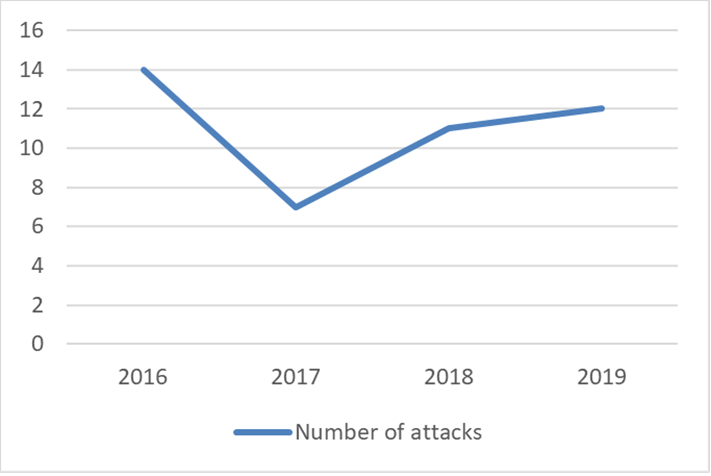
The establishment of the TCA, which was expected to function as a counterterrorism measure in the TBA, appears to have been ineffective in curbing the growth of terrorist activities operating in the Sulu-Sulawesi Seas. This phenomenon warrants further investigation to explain why the trilateral cooperation between Indonesia, Malaysia, and the Philippines has yet to succeed in suppressing terrorism in the TBA. In principle, regional security threats should be mitigated through cooperative arrangements among neighboring states. The period of 2017–2019 was selected for this study because 2017 marked the formal ratification of the TCA, and during these three years, ISIS activity in the TBA significantly increased.
Based on the foregoing discussion of the tangible threat of terrorism in the TBA and the establishment of the TCA as a counterterrorism measure in the region, this study poses the following research question: Why has the trilateral cooperation (also known as the TCA) between Indonesia, Malaysia, and the Philippines in the Sulu-Sulawesi Seas failed to curb the growth of ISIS in the Tri-Border Area?
Analytical Framework: Regional Security Complex Theory
This study seeks to explain why the trilateral cooperation between Indonesia, Malaysia, and the Philippines has failed to curb the growth of ISIS in the Tri-Border Area. This study addresses a critical gap in the application of Regional Security Complex Theory to the study of maritime security cooperation in Southeast Asia, a region that remains underrepresented in mainstream international relations scholarship. While RSCT has been extensively applied to regional dynamics in Europe, the Middle East, and South Asia, its explanatory potential for understanding non-traditional security challenges in maritime Southeast Asia has received minimal scholarly attention. The Trilateral Cooperative Arrangement (TCA) among Indonesia, Malaysia, and the Philippines thus offers a compelling empirical case through which to extend and test RSCT’s analytical framework beyond its conventional contexts.
Accordingly, this research employs the Regional Security Complex (RSC) theory developed by Buzan and Waever (2003) to provide a comprehensive and contextual understanding of regional maritime security dynamics in Southeast Asia—particularly in the Sulu-Sulawesi Seas, which are marked by the prevalence and proliferation of transnational crimes such as maritime piracy, hostage-taking, and terrorism.
Before elaborating on the RSC theory, it is important to first examine the evolution of the concept of security and its contribution to the formation of the RSC framework. Fundamentally, the understanding of security has long been contested among scholars and practitioners of International Relations. Waltz (1979), in his seminal work Theory of International Politics, classifies security as a defense mechanism within the context of anarchy, wherein states can only rely on themselves because other states cannot be trusted. This defense mechanism—manifested in war and the use of military forces—emerged as the primary response of states to survive under conditions of anarchy. The end of World War II marked a significant development in the security concept, expanding the scope of security studies beyond military power or traditional military forces to encompass a much broader range of considerations (Nye & Lynn-Jones, 1988).
Furthermore, Buzan, Wæver, and de Wilde (1998) advanced the concept of security by focusing on the processes of securitization, the complexity of regional security, and sectoral security. Buzan et al. (1998, p. 21) define security as:
“It is when an issue is presented as posing an existential threat to a designated referent object (traditionally, but not necessarily the state, incorporating government, territory, and society). The special nature of security threats justifies the use of extraordinary measures to handle them.”
Thus, the concept of security is no longer confined to discussions of military power and warfare, but has expanded to encompass non-traditional security threats.
Another key concept within the RSC theory is regional security. Buzan and Wæver (2003) outline the evolution of regional security in three stages: the modern era (1500–1945), the Cold War and decolonization period (1945–1989), and the post–Cold War era. During the modern era, Europe emerged as a global power, dominating the international system. Regional security issues were less prominent at this stage due to the prevalence of global rivalries among European states. The subsequent period had a profound impact on the development of regional security as decolonization led to the emergence of newly sovereign states. Concurrently, regional security issues became increasingly visible. The final stage, the post–Cold War period, saw a shift in the nature of regional security agendas, with a growing emphasis on non-traditional security threats.
The RSC theory offers a relevant framework for understanding the new structure of international politics in the post–Cold War era. According to this theory, a region consists of a group of geographically proximate states that share stronger relationships and more frequent interactions—characterized by patterns of amity and enmity—among themselves than with actors outside the regional constellation (Hammerstad, 2005). Such a region may be interconnected through economic dimensions, shared identities, and environmental externalities that necessitate the formation of a regional security complex (Kelly, 2007, pp. 197–229).
In their book Regions and Powers: The Structure of International Security, Buzan and Wæver define a Regional Security Complex as “a set of units whose major processes of securitization and de-securitization or both are so interlinked that their security problems cannot reasonably be analyzed or resolved apart from one another.” In other words, the RSC theory posits that states within a region are interconnected in such a way that the security issues of one state have significant implications for the security of its neighboring states (Buzan & Wæver, 2003, p. 44).
Geographical factors play a crucial role in the RSC theory. The central premise of this theory is that threats tend to travel more readily over short distances than over long ones, and that security interdependence is primarily formed on a regional basis (Buzan & Wæver, 2003, p. 4). Consequently, states at the regional level are more likely to establish security arrangements with one another than with states located in other regions. The formation of a regional security complex is also influenced by historical, socio-cultural, and economic factors among neighboring states, which shape the dynamics within the region (Buzan & Wæver, 2003, p. 43). Security interdependence, in turn, affects states by encouraging voluntary engagement and cooperation on a unilateral, bilateral, minilateral, or multilateral basis (Snedden, 2018, p. 3).
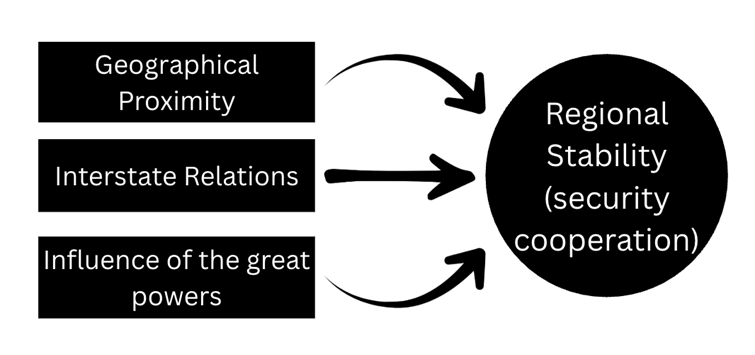
The existence of anarchy in the international system influences the RSC theory’s assessment of the role of great powers within that system (Sunawar, 2018). From a systemic perspective, regions may form subsystems that emerge from the interactions and connections among regional states. Great powers possess the capacity to engage in these regional affairs, for instance, through military or economic assistance. Such involvement can add to the complexity of regional security dynamics, either in a positive or a negative manner (Paul, 2012). Based on the foregoing explanation of RSC theory, it can be concluded that Buzan and Wæver (2003) identify several key variables in examining a regional security complex in the context of addressing security threats.
| Variables | Description |
|---|---|
| Geographical proximity | Geographical proximity plays a critical role in shaping security interdependence, as states located in close physical proximity are more likely to experience shared security concerns and heightened interconnectivity in their threat perceptions. |
| Interstate Relations | Examining the nature of interstate interaction within the region, whether characterized by relations of amity or, conversely, by enmity. |
| Influence of the great powers | Examining the interests, presence, and influence of great powers in the region, which in turn shape the dynamics of the regional security complex. External powers often penetrate a regional security complex, shaping its internal dynamics and influencing cooperative or competitive behavior among regional states. |
Source: Buzan, Waever, 2003; compiled by the Author (2025)
Source: created by the Author
The analysis of regional security dynamics in this study is based on both internal and external variables that shape the security complex. Internally, geographical proximity is crucial as neighboring states tend to share security concerns and are more interconnected in their perceptions of threats. Additionally, the nature of interstate relations—whether amity or enmity—significantly influences regional security interactions. Externally, the role of great powers is examined, focusing on their interests, presence, and influence, which have a considerable impact on shaping regional security dynamics. Together, these variables provide a comprehensive framework for understanding the complexities of the regional security environment and the factors affecting trilateral cooperation.
Methods
This study uses a descriptive qualitative and deductive approach to examine trilateral cooperation between Indonesia, Malaysia, and the Philippines in countering ISIS in the Tri-Border Area (TBA). The Regional Security Complex Theory (RSCT) guides the analysis, allowing assessment of how geographical proximity, interstate security interaction, and external power involvement shape cooperative responses. A qualitative design is employed as it enables contextual interpretation of regional threat perceptions and security behavior (Lamont, 2015).
Data were collected through library and desk research using purposive sampling to ensure relevance and credibility. Primary sources include official policy statements, defense white papers, and speeches by senior security officials from the three countries. Secondary sources consist of the U.S. Country Reports on Terrorism, Counter Terrorist Trends and Analyses (CTTA), RSIS Commentaries, Defense Forum publications, peer-reviewed journal articles, and established regional media outlets such as The Philippine Star. Only sources with clear authorship, institutional credibility, and editorial oversight were included; unverified or anonymous online materials were excluded. Data were analyzed through thematic coding aligned with RSCT variables, and cross-verification across databases, think-tank assessments, and official statements was conducted to minimize bias and strengthen validity.
In conducting this research, the author encountered challenges in obtaining certain secondary data, particularly detailed schedules of coordinated patrols under the Trilateral Cooperative Agreement (TCA), official government data on the number of ISIS-linked terrorist attacks in the TBA, and verified figures on foreign terrorist fighters who supported ISIS during the Marawi siege. These data gaps reflect both the sensitive nature of counterterrorism intelligence and uneven transparency across national reporting systems. The author hopes that such information will become more widely available through formal government release or collaboration with relevant non-governmental organizations. Despite this limitation, the study draws on triangulated, reputable, and cross-checked sources to provide a balanced and grounded assessment of trilateral security cooperation in the TBA.
Results and Discussion
This section analyzes the theory discussed in the preceding section. Accordingly, it is divided into three subsections. The first addresses the geographical proximity of the TCA member states. The second examines interstate interactions among Indonesia, Malaysia, and the Philippines in relation to counterterrorism cooperation. The third discusses the influence of great powers—specifically the United States—within the region. These explanations serve to answer the research question, namely, why the TCA cooperation has not yet succeeded in curbing the growth of ISIS in the TBA.
Geographical Proximity and the Expansion of ISIS in the Indonesia–Malaysia–Philippines Tri-Border Area
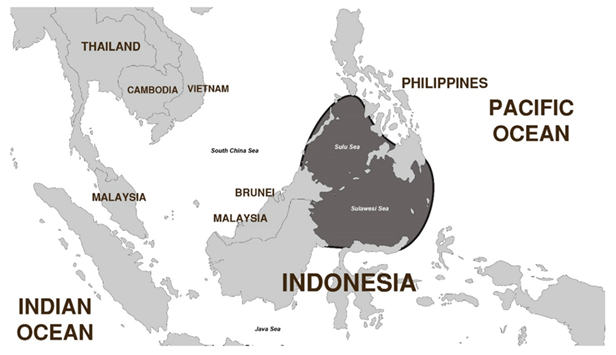
The Sulu Sea, located southwest of the Philippines, covers an area of 260,000 square kilometers and is bordered to the northwest by Palawan Island (Philippines), to the southeast by the Sulu Archipelago (Philippines), and to the southwest by Sabah (Eastern Malaysia) (Storey, 2018). The Celebes Sea, by contrast, has a surface area of 280,000 square kilometers and is bordered by the Sulu Sea to the north, the Sangihe Islands to the east, Sulawesi to the south, and East Kalimantan to the west (Febrica, 2014).
Source: Febrica & Myers (2024)
The geographical proximity of Indonesia, Malaysia, and the Philippines—interconnected through the Sulu-Sulawesi Seas—renders these states vulnerable to terrorism threats and has facilitated the expansion of ISIS in the region. ISIS-affiliated terrorist groups exploit this area to support the planning and execution of terrorist activities.
Terrorist acts carried out by ISIS-affiliated groups in the TBA increased between 2017 and 2019. The perpetrators of these attacks were not limited to domestic individuals or terrorist groups, but also included cross-border actors. The Siege of Marawi in the southern Philippines, which lasted from May to November 2017, involved 80 foreign terrorist fighters from Indonesia and Malaysia (Yusa, 2018). A Malaysian militant, Dr. Mahmud bin Ahmed, was reported to have played a central role as the mastermind behind the Marawi siege (Gunaratna, 2017).
Source: The U.S. State Department Annual Report on Terrorism, compiled by the Author (2025)
The Siege of Marawi
The Siege of Marawi represents one of the most devastating and perilous acts of terrorism in Southeast Asia, perpetrated by pro-ISIS groups. The territorial control took place in the provincial capital of Lanao del Sur, Mindanao, in the southern Philippines, and lasted for five months—from May to November 2017. Marawi became the first city outside the Middle East and North Africa to fall under ISIS control (Samuel, 2017). One year prior to the siege, ISIS had declared the southern Philippines a wilayat (province) and appointed Isnilon Hapilon as its regional leader in Southeast Asia. Abu Bakr al-Baghdadi, the leader of ISIS, reportedly instructed Hapilon to plan the siege of Marawi between March and April 2017 (Buan, 2017).
The conflict officially began on 23 May 2017, under the leadership of the Maute Group, also known as the Islamic State Lanao (ISL), with the participation of FTFs who entered Marawi under the pretext of attending a Jamaah Tabligh gathering. ISIS militants began seizing key government buildings and setting fire to churches and schools. It was estimated that they initially deployed around 300 militants in the assault on Marawi. This number included approximately 150 Islamic State of Lanao (Maute Group) fighters, 40 foreign terrorist fighters (mostly from Indonesia and Malaysia), 50 members of the Abu Sayyaf Group, 30 Balik Islam members, and 30 Maguindanaon militants (Gunaratna, 2017).
The confrontation between ISIS and the Armed Forces of the Philippines (AFP) resulted in significant casualties and triggered a severe humanitarian crisis. According to official government reports, more than 800 militants, including Isnilon Hapilon and Omar Maute, as well as 160 government soldiers, were killed in the armed clashes since 23 May 2017. The crisis also displaced approximately 360,000 people or 72,000 families (Romero, 2017). This made the Siege of Marawi the deadliest military engagement in the history of the Philippines in terms of casualties.
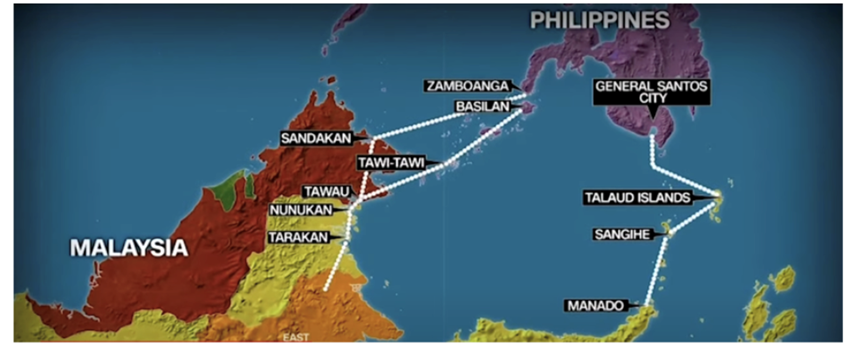
In the aftermath of the Marawi siege by ISIS, 100 ISIS militants from Indonesia and Malaysia were reported to have continued arriving to support ISIS operations in the region. Malaysian ISIS militants traveled from Sabah to Tawi-Tawi Island in the Philippines before proceeding to Marawi. In contrast, Indonesian ISIS militants used a different route, traveling from Manado to the Sangihe Islands, then onward to General Santos, Davao, and ultimately Marawi (Yusa, 2018). Another case was the bombing carried out by Indonesian nationals in the Philippines. In January 2019, an Indonesian husband-and-wife pair conducted a suicide bombing at the Cathedral of Our Lady of Mount Carmel in Jolo. They traveled from Indonesia to Mindanao via the Sulu Archipelago (Kumendong & Wibisono, 2024).
Source: Watson (2017)
From the perspective of Regional Security Complex Theory, geographical proximity defines the spatial boundaries within which security interdependence emerges. In the case of the Indonesia–Malaysia–Philippines Tri-Border Area, proximity not only generates shared vulnerabilities but also demands effective collective surveillance to manage transnational threats. However, the porous maritime geography of the Sulu–Sulawesi Seas, combined with limited state capacity and uneven implementation of the JMP, has weakened border control and situational awareness.
This condition created a permissive environment for the movement of foreign terrorist fighters (FTFs) and the circulation of weapons and illicit funding across maritime borders. Consequently, southern Philippines (particularly Mindanao and the Sulu Archipelago) became the primary battleground for ISIS operations in Southeast Asia.
Although proximity should foster cooperative security responses, in this case, it amplified transnational threats instead, as porous borders and limited maritime surveillance enabled ISIS militants to operate fluidly across the three states’ territories. The failure to transform geographical interdependence into coordinated security control mechanisms contributed to the persistence of ISIS networks in the area.
Interstate Interaction Among Indonesia, Malaysia, and the Philippines: Implications for ISIS Expansion in the Tri-Border Area
In May 2016, Indonesia, Malaysia, and the Philippines agreed to a joint declaration establishing the Trilateral Cooperative Arrangement (TCA) in the Sulu-Sulawesi Seas. Six months later, the three countries reached an agreement on the operationalization of the TCA, which involved conducting Joint Maritime Patrols (JMP), one of the programs of the TCA, to safeguard maritime security in the area. In June 2017, the TCA was officially ratified and began operations. However, its launch was not accompanied by an agreement on the standard operating procedures (SOPs) to be applied in the implementation of the JMP.
The lengthy period between the joint declaration and the official ratification of the TCA, coupled with the absence of established SOPs for the JMP, indicates a degree of reluctance and mutual distrust among the three states toward the trilateral cooperation. Since the establishment of the TCA, the member states have never conducted a joint JMP; instead, cooperation has been limited to optimizing the operations of their respective Maritime Command Centres (Ministry of Defense of the Republic of Indonesia, 2022). Furthermore, there was no discussion of the JMP during the TCA annual meeting held in June 2022 (Da Costa, 2022).
The issue of distrust among TCA member states, which has resulted in the non-implementation of the JMP, is closely linked to ongoing territorial disputes among the three countries. In the Sulawesi Sea, Indonesia has experienced a territorial dispute with Malaysia over the Ambalat Block. The Ambalat Block is a maritime area covering 15,235 square kilometers in the Sulawesi Sea, containing an estimated 421.61 million barrels of crude oil and 3.3 trillion cubic feet of natural gas (Kompas, 2008). Rich in gas and mineral resources, this area holds significant economic value. The dispute over maritime boundaries in Ambalat dates back to 1969 between Indonesia and Malaysia.
Tensions over the Ambalat conflict have been met with displays of military force between Indonesia and Malaysia. In 2005, provocations between the Indonesian and Malaysian navies resulted in three collisions between the Indonesian warship KRI Tedong Naga and the Malaysian warship KD Rencong (Tempo, 2005). Four decades have passed, yet the Ambalat Block dispute remains unresolved between the two states. Throughout 2015, the Indonesian Navy reported nine violations by Malaysian aircraft entering Indonesian airspace, particularly over the Ambalat Block. In response to these incursions, Indonesia deployed military forces to the border areas of North Kalimantan, including the Ambalat waters, to demonstrate its commitment to defending the territory of its outermost regions (Druce & Baikoeni, 2016).
A similar case has occurred between Malaysia and the Philippines in the Sulu Sea regarding territorial claims over Sabah. Sabah, also known as North Borneo, is located approximately 500 kilometers from the Philippines. Since 1963, Sabah has been declared part of Malaysia based on a public referendum in which the population decided to join the Malaysian Federation (Malindog-Uy, 2020). This declaration has been rejected by the Philippines, which asserts that Sabah is part of its territory in accordance with the 1878 “Lease Treaty.” The treaty stipulates that Sabah was granted by the Sultanate of Brunei to the Sultanate of Sulu and thus constitutes a legitimate part of the Philippine state (Ao, 2020).
The protracted conflict over Sabah has had a negative impact on bilateral relations between Malaysia and the Philippines. Tensions between the two countries escalated in 2013 when, on 11 February, 200 members of the Royal Army of Sulu attacked the town of Lahad Datu, Sabah, resulting in the deaths of 68 Sulu Sultanate forces, 9 Malaysian armed forces personnel, and 6 civilians (CNN, 2021). To this day, the dispute over Sabah remains unresolved, and bilateral relations between Malaysia and the Philippines continue to be marked by mutual suspicion.
Territorial disputes among TCA member states have also hindered the implementation of the “right of pursuit,” a provision within the TCA agreement. The right of pursuit refers to a situation in which a country’s security forces enter or cross into another member state’s jurisdiction while in active pursuit of criminals. Leaders of the three TCA member states have stated that their forces may enter each other’s territory when pursuing terrorists (Glang, 2017). However, this provision has never been exercised due to the sensitivity of the aforementioned territorial claims.
Given the complexity of relations among the member states of the TCA, their interactions reflect a persistent level of distrust rooted in unresolved historical territorial disputes and divergent national interests. According to RSC theory, patterns of enmity or distrust stemming from past conflicts can significantly constrain the effectiveness of regional cooperation. This dynamic is evident in the TCA, where the lack of mutual confidence has hindered the institutionalization of crucial mechanisms such as the JMP, an initiative intended to enhance maritime surveillance and counterterrorism coordination.
Consequently, mutual distrust and bureaucratic asymmetries among TCA members have undermined intelligence sharing and real-time operational coordination. The persistence of “soft sovereignty sensitivities” and divergent threat perceptions has further prevented the establishment of a cohesive and integrated security framework. As a result, ISIS and its affiliated networks have been able to exploit governance gaps and porous borders in the Sulu–Sulawesi Seas, maintaining operational freedom and facilitating the continued spread of militancy across the Tri-Border Area.
The United States’ Influence and Interests in Southeast Asia and Their Impact on ISIS Expansion in the Tri-Border Area
This study finds that the great power exerting the most significant influence on the development of ISIS in the TBA is the United States. In early 2016, ISIS lost much of its territorial stronghold in Iraq and Syria as a result of offensives by the Syrian government and the U.S.-led coalition. This prompted the group to seek a new base and ultimately declare the southern Philippines as its wilayat in Southeast Asia (Gunaratna, 2016). The United States viewed this as a threat to regional security, with potential implications for regional economic dynamics (Lamothe, 2017). Consequently, the United States became involved in safeguarding regional security by participating in efforts to combat ISIS in Southeast Asia, particularly in the TBA.
The influence of the United States on the development of ISIS in the TBA can be examined from the U.S.–Philippines military cooperation in counterterrorism. Security cooperation between the United States and the Philippines began with the signing of the Mutual Defense Treaty in 1951 and was further strengthened in 2014 through the Enhanced Defense Cooperation Agreement (U.S. Department of State, 2022). In terms of counterterrorism, the Philippines received USD 3.9 billion in assistance from the United States between 2019 and 2022, most of which was allocated for the modernization of the Armed Forces of the Philippines (AFP) (Suansing, 2022). Furthermore, the United States was the only country to assist the Philippines in combating ISIS in Marawi, providing logistical support, intelligence, military training, and defense equipment (Morales & Lewis, 2018).
Nevertheless, U.S. financial and logistical assistance does not appear to have provided a significant solution for eradicating ISIS in the Philippines or in the TBA. The data below indicate that terrorist attacks by ISIS have continued to occur in close succession. Notably, the suicide bombing in Jolo stands as one of the deadliest such attacks, claiming 23 lives and injuring 100 others (Banlaoi, 2020).
| Date | Location | Description |
|---|---|---|
| 31 July 2018 | Lamitan, Basilan | Suicide bombing by German and Moroccan nationals |
| 27 January 2019 | Jolo, Sulu | Suicide bombing by two Indonesian nationals |
| 28 June 2019 | Indanan, Sulu | Suicide bombing by a Filipino national |
| 8 September 2019 | Indanan, Sulu | Suicide bombing by a Filipino national |
Source: Banlaoi (2020), compiled by the Author (2025)
The involvement of great powers in maritime Southeast Asia plays a crucial role in assisting regional states in addressing shared security threats. However, evidence suggests that U.S.–Philippine military cooperation in counterterrorism operations—particularly in the Philippines and the Sulu–Sulawesi Seas—has remained predominantly technical in nature, emphasizing military modernization, funding, and logistical assistance rather than comprehensive strategies aimed at tackling the underlying drivers of terrorism in the TBA.
The resurgence of ISIS-affiliated suicide bombings in the Sulu–Sulawesi Seas following the 2017 Marawi siege underscores the limited effectiveness of U.S. support in suppressing ISIS’s regional expansion. The region’s reliance on U.S. security assistance has generated asymmetrical dependencies, weakening the sense of regional ownership within the TCA. In line with RSCT, such external penetration disrupts regional cohesion and impedes the development of an autonomous and unified response to the threat posed by ISIS in the TBA.
Conclusion
The implementation of trilateral cooperation among Indonesia, Malaysia, and the Philippines through the Trilateral Cooperative Arrangement (TCA) has been largely ineffective in curbing the expansion of ISIS in the Tri-Border Area (TBA) between 2017 and 2019. Despite the formal establishment of the TCA in 2017, ISIS has continued to conduct terrorist attacks and maintain operational networks across the three member states. Ideally, such a regional mechanism should have strengthened intelligence sharing, enhanced maritime surveillance, and restricted the movement of terrorist groups. However, empirical developments demonstrate that the persistence of ISIS is closely linked to three interrelated causal factors namely, geographical proximity, interstate mistrust, and the influence of external power as identified in Buzan and Wæver’s (2003) Regional Security Complex Theory (RSCT).
First, the geographical proximity of Indonesia, Malaysia, and the Philippines, coupled with the porous and weakly monitored maritime borders of the Sulu–Sulawesi Seas, has been exploited by ISIS and its affiliates to facilitate the movement of foreign terrorist fighters (FTFs), weapons, and financial resources. This geographical interconnection, instead of fostering coordinated border management, created shared vulnerabilities without shared control.
Second, interstate relations within the TCA have been constrained by mutual distrust, sovereignty sensitivities, and divergent threat perceptions, which have undermined efforts to institutionalize key mechanisms such as the Joint Maritime Patrols (JMP). The absence of trust and synchronized operational frameworks has prevented the TCA from evolving into a cohesive regional security mechanism.
Third, the involvement of great powers, particularly the United States, has been limited to technical and logistical support which focuses on military modernization and capacity-building programs rather than addressing the root causes of terrorism in the TBA. This dependence on external assistance has produced asymmetrical security relationships, weakening regional autonomy and coherence in responding to the ISIS threat.
Taken together, these factors illustrate that RSCT provides a comprehensive analytical framework for understanding the constraints faced by regional cooperation mechanisms in addressing non-traditional security threats such as terrorism. The geographical vulnerabilities, political mistrust, and external dependencies that characterize the TCA demonstrate how structural and relational factors interact to weaken regional security governance. Consequently, the TCA’s underperformance reflects not only the limitations of institutional design but also the broader dynamics of regional insecurity and external penetration that shape the security landscape of maritime Southeast Asia.
Bibliography
Abke, T. (2019, June 3). Trilateral air, maritime patrols curtail kidnappings. Indo-Pacific Defense Forum. https://ipdefenseforum.com/2019/06/trilateral-air-maritime-patrols-curtail-kidnappings/
Ao, T. (2020, August 27). The discord over Sabah between Malaysia and the Philippines. Indian Council of World Affairs. https://www.icwa.in/show_content.php?lang=1&level=3&ls_id=5311&lid=3744
Asia Society Policy Institute. (2022). Are minilaterals the new multilateral in the Indo-Pacific? https://asiasociety.org/policy-institute/are-minilaterals-new-multilateral-indo-pacific-0
Banlaoi, R. (2020, May 22). Three years after Marawi siege: Terrorism in the Philippines persists amidst COVID-19 pandemic. Institute for Autonomy and Governance. https://iag.org.ph/think/1888-three-years-after-marawi-siege-terrorism-in-the-philippines-persists-amidst-covid-19-pandemic
BBC News. (2016). What is the South China Sea dispute? https://www.bbc.com/news/world-asia-pacific-13748349
BBC News. (2017, October 16). Philippines unrest: Who are the Abu Sayyaf group? https://www.bbc.com/news/world-asia-41638747
Buan, L. (2017, June 13). Calida: Military knew Marawi terror plot as early as April. Rappler. https://www.rappler.com/nation/172777-isis-military-marawi-crisis-martial-law-calida
Buzan, B., & Wæver, O. (2003). Regions and powers: The structure of international security. Cambridge University Press. https://doi.org/10.1017/CBO9780511491252
Buzan, B., Wæver, O., & de Wilde, J. (1998). Security: A new framework for analysis. Lynne Rienner Publishers.
Chakraborty, S. (2022, October 28). Minilateralism in the Indo-Pacific: Is it the future? The Geopolitics. https://thegeopolitics.com/minilateralism-in-the-indo-pacific-is-it-the-future/
Chandran, N. (2016, November 22). Forget Trump and China, piracy in the Sulu Sea is a fresh threat to Asia trade. CNBC. https://www.cnbc.com/2016/11/22/forget-trump-china-sulu-sea-piracy-is-threat-to-asia-trade.html
CNN Indonesia. (2021, December 14). Pejabat Filipina dituding serukan plot invasi Sabah Malaysia. https://www.cnnindonesia.com/internasional/20211214091533-106-733727/pejabat-filipina-dituding-serukan-plot-invasi-sabah-malaysia/2
Da Costa, G. (2022, June 21). Southeast Asian partners enhancing trilateral maritime patrols. Indo-Pacific Defense Forum. https://ipdefenseforum.com/2022/06/southeast-asian-partners-enhancing-trilateral-maritime-patrols/
Druce, S. C., & Baokeni, E. Y. (2016). Circumventing conflict: The Indonesia–Malaysia Ambalat block dispute. In M. Oishi (Ed.), Contemporary conflicts in Southeast Asia: Toward a new ASEAN way of conflict management (pp. 137–156). Springer. https://doi.org/10.1007/978-981-10-0042-3_7
Febrica, S. (2014). Securing the Sulu–Sulawesi Seas from maritime terrorism: A troublesome cooperation? Perspectives on Terrorism, 8(3). http://www.terrorismanalysts.com/pt/index.php/pot/article/view/347
Febrica, S., & Myers, L. (2024). United States–Indonesia maritime and environmental security in the Sulu–Sulawesi Sea (Policy paper). Hollings Center for International Dialogue. https://hollingscenter.org/us-indonesia-maritime-security-in-the-sulu-sulawesi-sea/
Glang, H. (2017, January 14). Duterte allows Malaysia-Indonesia help against pirates. Anadolu Agency. https://www.aa.com.tr/en/asia-pacific/duterte-allows-malaysia-indonesia-help-against-pirates/727407
Gunaratna, R., & Hornell-Scott, N. (2016). The Islamic State’s wilayats and global expansion. Counter Terrorist Trends and Analyses, 8(3–7), 4.
Hammerstad, A. (2005). Domestic threats, regional solutions? The challenge of security integration in Southern Africa. Review of International Studies, 31(1), 69–87. https://doi.org/10.1017/S0260210505006303
Hastings, J. V. (2011). No man’s land: Globalization, territory, and clandestine groups in Southeast Asia. NUS Press.
Hidayat, R. (2017, June 19). Komando militer di Tarakan dinilai “tak efektif bendung ISIS” di Marawi. BBC News Indonesia. https://www.bbc.com/indonesia/indonesia-40330939
Ho, J. (2006). The security of sea lanes in Southeast Asia. Asian Survey, 46(4), 558–574. https://doi.org/10.1525/as.2006.46.4.558
Johnston, P. B., & Clarke, C. P. (2017, November 27). Is the Philippines the next caliphate? Foreign Policy. https://foreignpolicy.com/2017/11/27/is-the-philippines-the-next-caliphate/
Kelly, R. (2007). Security theory in the “new regionalism.” International Studies Review, 9(2), 197–229. https://doi.org/10.1111/j.1468-2486.2007.00671.x
Lamont, C. (2015). Research methods in international relations (2nd ed.). SAGE Publications.
Lamothe, D. (2017, June 12). Bloody combat in a Philippine city highlights U.S. concerns about ISIS in Asia. The Washington Post. https://www.washingtonpost.com/news/checkpoint/wp/2017/06/12/bloody-combat-in-a-philippine-city-highlights-u-s-concerns-about-isis-in-asia/
Mauna, B. (2008). Hukum internasional: Pengertian, peranan, dan fungsi dalam era dinamika global. Penerbit Alumni.
Morales, N. J., & Lewis, S. (2017, June 10). U.S. joins battle as Philippines takes losses in besieged city. Reuters. https://www.reuters.com/article/us-philippines-militants/u-s-joins-battle-as-philippines-takes-losses-in-besieged-city-idUSKBN19107I
Nye, J. S., & Lynn-Jones, S. M. (1988). International security studies: A report of a conference on thestate of the field. International Security, 12(4), 5–27. https://doi.org/10.2307/2538992
Paul, T. V. (Ed.). (2012). International relations theory and regional transformation. Cambridge University Press. https://doi.org/10.1017/CBO9781139096836
Storey, I. (2018). Trilateral security cooperation in the Sulu–Celebes Seas: A work in progress. ISEAS Perspective, 48. https://www.iseas.edu.sg/images/pdf/ISEAS_Perspective_2018_48@50.pdf
U.S. Department of State. (2016–2019). Country reports on terrorism. https://www.state.gov
U.S. Department of State. (2022, October 7). U.S. security cooperation with the Philippines. https://www.state.gov/u-s-security-cooperation-with-the-philippines/
Waltz, K. (1979). Theory of international politics. McGraw-Hill.
Watson, I. (2017, June 28). How ISIS established a foothold in Southeast Asia [Video]. YouTube. https://www.youtube.com/watch?v=-p8N-0CYKA
Yusa, Z. (2018, November 20). Malaysia and Indonesia foreign fighter transit routes to the Philippines identified. The Defense Post. https://thedefensepost.com/2018/11/20/malaysia-indonesia-philippines-foreign-fighters-transit-routes/