Navigating Maritime Politics: A Systematic Review and Bibliomatric Mapping
Bahjatul Murtasidin1* , Sandy Pratama1, Putra Pratama Saputra2
1Department of Political Science, Universitas Bangka Belitung, 33172,Kepulauan Bangka Belitung-Indonesia
2Department of Sociology, Universitas Bangka Belitung, 33172,Kepulauan Bangka Belitung-Indonesia
Abstract
Abstract Maritime affairs constitute a strategic domain within contemporary geopolitical dynamics. In recent decades, maritime spaces have ascended as a critical arena for power projection, driven by intensifying global competition. This study employs a systematic mapping approach to delineate the evolution and predominant research trends within maritime political studies. Utilizing bibliographic data from the Scopus database in the period of 2005–2025, we analyzed a corpus of scientific articles on maritime politics. The data were processed using the VOSviewer software to generate a network map of keywords, elucidate inter-topic relationships, and trace conceptual developments. The analysis reveals five dominant keywords that form the discursive core: marine policy, governance, the marine environment, ocean governance, and marine governance. These themes are not isolated but are intricately interconnected within a conceptual network, illustrating the trajectory of maritime politics over the past two decades. The inter topic relationships signify the integration of ecological and political imperatives, shaping an emergent governance model characterized by its trans boundary, collaborative, and sustainability-oriented nature. This evolution represents an epistemological shift from a state-centrist paradigm, through a governance paradigm, toward a nascent ecological-political paradigm. Consequently, the sea is no longer conceived merely as an economic or territorial domain, but is increasingly recognized as a complex and dynamic political space.
Keywords: Governance Approach; Marine Environment; Marine Governance; Marine Policy; Maritime Politics; Ocean Governance
Abstrak
Abstrak Kemaritiman merupakan salah satu isu strategis dalam dinamika politik global kontemporer. Dalam beberapa dekade terakhir, wilayah maritim telah menjelma menjadi ruang kekuasaan karena persaingan geopolitik global. Penelitian ini menggunakan pendekatan pemetaan sistematis untuk mengidentifikasi perkembangan serta tren penelitian dominan dalam studi politik maritim. Dengan memanfaatkan data bibliografis dari basis data Scopus pada periode 2005–2025, penelitian ini menganalisis kumpulan artikel ilmiah yang membahas politik maritim. Data diolah menggunakan perangkat lunak VOSviewer untuk menghasilkan peta jejaring kata kunci, mengungkap hubungan antar-topik, serta menelusuri perkembangan konseptual. Hasil analisis menunjukkan lima kata kunci dominan yang membentuk inti diskursus, yaitu kebijakan kelautan, tata kelola, lingkungan laut, tata kelola laut, dan tata kelola kelautan. Tema-tema tersebut tidak berdiri sendiri, melainkan saling terhubung secara erat dalam suatu jaringan konseptual yang menggambarkan lintasan perkembangan politik maritim selama dua dekade terakhir. Hubungan antar-topik ini mencerminkan integrasi antara kepentingan ekologis dan politik, yang membentuk model tata kelola baru bersifat lintas batas, kolaboratif, dan berorientasi pada keberlanjutan. Perkembangan ini menunjukkan adanya pergeseran epistemologis dari paradigma negara-sentris, menuju paradigma tata kelola, dan selanjutnya ke arah paradigma ekologi-politik yang mulai mengemuka. Dengan demikian, laut tidak lagi dipahami semata-mata sebagai ruang ekonomi atau teritorial, melainkan semakin diakui sebagai ruang politik yang kompleks dan dinamis.
Kata Kunci: Kebijakan Kelautan; Lingkungan Laut; Pendekatan Tata Kelola; Politik Maritim; Tata Kelola Kelautan; Tata Kelola Laut.
Introduction
Maritime politics constitutes a critical nexus within the contemporary global geopolitical order. The realignment of global power, coupled with intensifying contestations over access to transoceanic trade routes and the exploitation of marine resources, has positioned the maritime domain as a central arena of international politics (Bueger, 2015; Summers, 2023). These contestations fundamentally concern the authority to establish norms, regulate marine resources, and exert military dominance. Consequently, maritime politics gains heightened urgency, functioning as a critical mechanism in the restructuring of global economic power and the processes of capital accumulation (Bueger & Edmunds, 2020). In this context, hegemony over major maritime trade routes equates to command over the global circulation of goods, energy, and capital.
Beyond its geopolitical and economic dimensions, maritime politics is inextricably linked to security, though the concept of ‘maritime security’ has undergone significant conceptual expansion. Previously confined to a militaristic framework of territorial integrity and sea lane protection, it now encompasses a broader ‘maritime security complex’ that includes ecological degradation, human migration, trans-boundary crime, and piracy (Bueger, 2015). This evolution signifies that maritime politics increasingly embodies a form of post-territorial governance—one that necessitates multilateral cooperation, global norm-setting, and inclusive institutional frameworks, transcending traditional notions of absolute sovereignty (Bueger & Edmunds, 2020).
Furthermore, the global climate crisis and the imperative of sustainability are deeply interwoven with maritime security. The ocean's capacity to absorb over 30 percent of global carbon emissions establishes it as a vital buffer for the global climate system. However, the over exploitation of marine resources precipitates ecosystem degradation (Campling et al., 2024; Havice, 2021), thereby threatening planetary life-support systems. It is therefore imperative to re-conceptualize maritime governance not merely through the lens of security and sovereignty, but as a matter of global responsibility for planetary sustainability. Maritime politics thus emerges as the crucial interface for mediating national interests and global ecological imperatives.
Synthesizing this literature reveals that maritime politics entails a re-articulation of global power orchestration. Command of the maritime domain translates into control over energy, food security, global logistics, and the digital infrastructure underpinning the global economy via submarine cables. In an era defined by digitization and energy transition, the sea has become indispensable infrastructure for the perpetuation of global capitalism; consequently, maritime politics is, unequivocally, the politics of the future. It is critical to recognize that this domain can serve as an arena for hegemonic struggles over global resources, yet it also provides a platform for negotiating a delicate equilibrium between security, economic, social, and environmental imperatives.
The phenomena delineated above illustrate the dynamic evolution of maritime politics as a field of study. Scholarly interest has surged over the past two decades, mirroring the growing salience of maritime issues in global policy agendas. A significant portion of the literature concentrates on maritime security and law (Bueger, 2015; Oxman, 2020), geopolitics, and diplomacy, particularly as they pertain to interstate power dynamics in the Indo-Pacific (Bueger & Edmunds, 2020). Despite this growing corpus, the methodological landscape remains under explored. There is a conspicuous scarcity of research employing bibliometric methods to systematically map the intellectual structure, thematic evolution, and collaborative networks within maritime political studies. Consequently, the knowledge base remains fragmented, lacking a comprehensive synthesis to forge a robust, cross-disciplinary conceptual framework. This gap underscores an urgent need to systematically and empirically investigate the constitution of maritime politics across global and local contexts
This study is designed to address this lacuna by conducting a systematic bibliometric analysis of scholarly publications on maritime politics from 2005 to 2025. The research aims to delineate dominant thematic trends, map collaborative networks among authors and institutions, and uncover the epistemological shifts guiding the field's development. In doing so, this study not only provides a definitive intellectual cartography of a rapidly evolving discipline but also offers critical reflections to guide future research toward just and sustainable ocean governance.
Methods
This study adopts a qualitative research design that integrates bibliometric analysis with a systematic literature review. Bibliometric analysis, a well-established method for mapping scientific literature, utilizes quantitative techniques to examine relationships between scholarly entities such as publications, authors, keywords, and institutions (Carradore, 2024; Donthu et al., 2020, 2021; Ellegaard & Wallin, 2015). This approach enables the objective identification of a field's intellectual structure, prevailing research trends, and its evolutionary trajectory (Aria & Cuccurullo, 2017). Complementing this, a systematic review provides a rigorous, protocol-driven framework for identifying, evaluating, and synthesizing all relevant research on a specific topic (Satnarine, 2023). The synergistic combination of these two methods facilitates a holistic investigation into maritime politics research. It captures not only the quantitative, structural dimensions of the field such as collaborative networks and influential contributors but also enables a qualitative, in-depth analysis of its conceptual themes and epistemological developments.
Data for this analysis were published at the Scopus database, selected for its comprehensive coverage, rigorous curation, and multidisciplinary scope, which ensures access to high-impact, internationally recognized literature. The research procedure follows the established guidelines for systematic mapping studies, as outlined below:
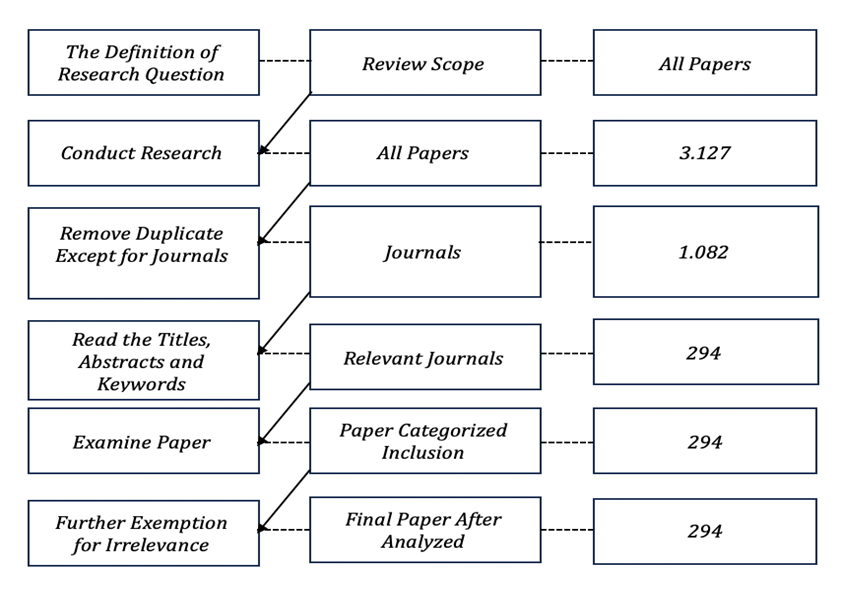
Source:(Petersen et al., 2008)
The data collection was began with a comprehensive search of the Scopus database. The primary search term, "maritime politics," was supplemented with a suite of synonymous and thematically related keywords including ocean governance; maritime geopolitics; sea power; and blue politics to ensure a robust retrieval of relevant literature. This initial search returned 3,127 journal articles. A multi-stage filtering process was then implemented to refine the dataset. The results were limited to articles published within the last decade, confined to the social sciences discipline, and restricted to the document type article published in English. This initial filtration narrowed the corpus to 1,082 articles. A final refinement was performed by screening article titles and keywords for direct relevance to the study's focus, yielding a final, curated dataset of 294 articles. This dataset was exported in CSV format for subsequent analysis.
VOS viewer is used to visualize bibliographic data or datasets containing bibliographic elements (such as title, author name, author affiliation, and publication journal) based on co-occurrence. The analysis employed a tripartite framework: Descriptive Analysis, to quantify the annual scientific production and identified the most influential authors, institutions, and countries within the field; Intellectual Structure, this approach mapped the collaborative networks and the foundational literature that shape the field's knowledge domain; and Conceptual Structure, to identify the key concepts and themes prevalent in maritime politics research, grouping them into distinct thematic clusters to reveal the field's conceptual architecture (Bender & Leodir Lobler, 2023).
Results and Discussion
Publication Trends in Maritime Politics Research
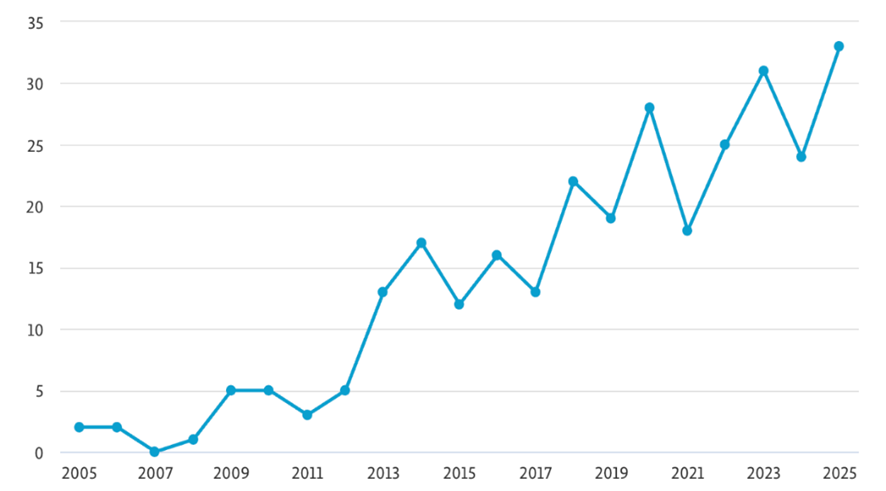
Analysis of the 294 publications reveals distinct temporal trends in the scholarly output on maritime politics from 2005 to 2025. As illustrated in Figure 1, publication rates remained relatively low in the initial years of the study period but demonstrated a marked and consistent upward trajectory beginning in the early 2010s.
source : research data analysis in www.scopus.com, 2025
An analysis of 295 scientific articles reveals dynamic shifts in scholarly attention to maritime politics between 2005 and 2025. The field experienced a low-output initial first phase, with a mere 2 to 5 publications annually until 2012. At the second phase, commencing around 2013, marks a pronounced increase in scholarly output. Despite some volatility, including slight decreases in 2015 and 2017, the general trend rose sharply, culminating in 20 to 33 annual publications by the period's end. This pattern signifies a substantial growth in academic interest in maritime politics over the last decade. Although publications on maritime politics have gradually increased in the 21st century, reaching 20 to 33 annually, this output remains modest, indicating the topic has yet to enter the academic mainstream.
This pattern signifies a substantial and growing engagement with maritime politics as a field of study. The pronounced increase in publications post-2010 correlates directly with the rising global salience of maritime disputes, governance challenges, and the strategic importance of ocean spaces, reflecting the field's responsive evolution to contemporary geopolitical and environmental issues.
The Leading Authors, Institutions, and Countries Contributing to the Field of Maritime Politics
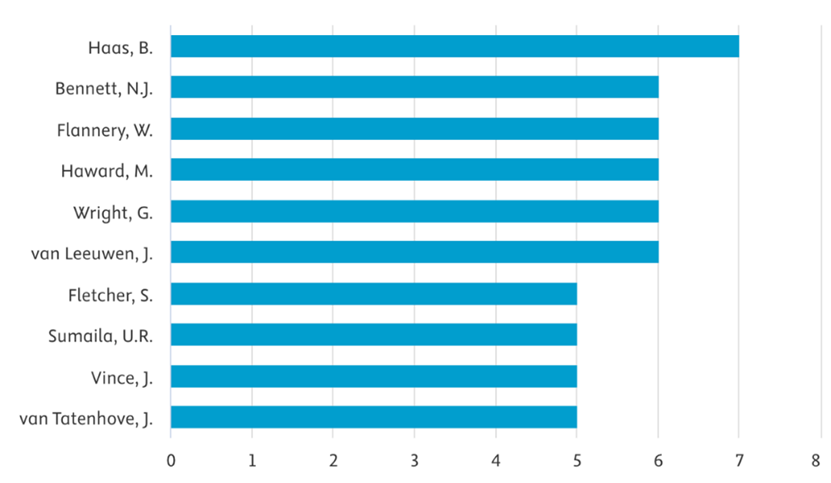
Grafik 2 lists the 15 most prolific authors on the topic of maritime politics between 2005 and 2025:
source : research data analysis in www.scopus.com, 2025
Grafik 2 identifies the most prolific contributors to maritime politics scholarship. Leading this cohort is Bianca Haas, with seven publications that primarily investigate blue growth and sustainable marine governance within a European context. She is followed closely by several authors, each with six articles, whose work defines key sub-fields: Nathan J. Bennett's research focuses on blue justice and social-ecological dimensions of marine resource management; while Wesley Flannery and Marcus G. Haward studies on marine spatial planning and ocean governance as foundational elements of modern maritime political regimes particularly in the North Atlantic and Indo-Pacific. Similarly, Glen W. Wright and Judith van Leeuwen, also with six articles each, examine the intersection of international marine governance and climate policy, offering critiques of blue economy paradigms that prioritize economic growth over social-ecological sustainability.
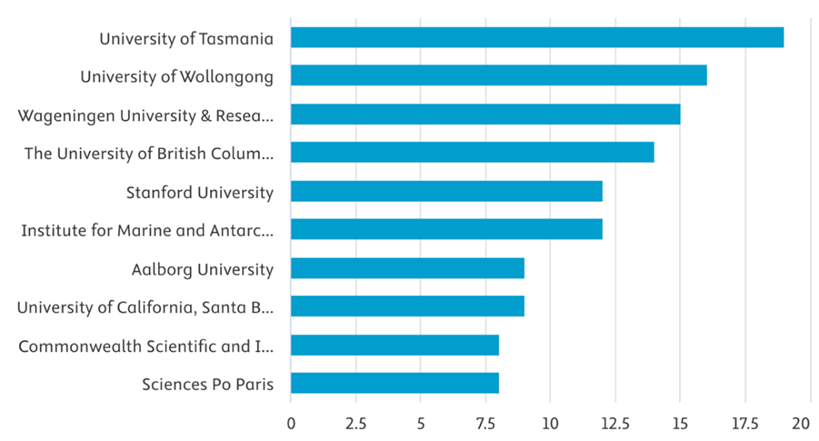
A subsequent tier of contributors including Stephen W. Fletcher, Ussif Rashid Sumaila, Joanna Zofia Vince, and Jan P.M. Van Tatenhove have each authored five articles. Their collective work strengthens the conceptual and empirical foundations of the field through interdisciplinary approaches spanning marine economics, conservation policy, and institutional analysis. Beyond individual authorship, the data reveal the leading institutional contributors to this domain. The most prominent affiliated institutions include the University of Tasmania, the University of Wollongong, Wageningen University & Research, the University of British Columbia, Stanford University, the Institute for Marine and Antarctic Studies, Aalborg University, the University of California, Santa Barbara, the Commonwealth Scientific and Industrial Research Organisation, and Sciences Po Paris.
source : research data analysis in www.scopus.com, 2025
The geographic and institutional distribution of leading research affiliates reveals a clear pattern in the global landscape of maritime politics, with Australian universities—particularly the University of Tasmania and the University of Wollongong—emerging as central hubs alongside institutions such as Wageningen University & Research and the University of British Columbia. Australia’s prominence cannot be explained by geography alone; rather, it reflects the political centrality of maritime space to the Australian state, where oceans constitute key arenas of sovereignty, security, economic development, and environmental governance. This centrality is institutionally embedded through interdisciplinary research infrastructures that integrate political science, marine ecology, law, and sustainability studies, enabling maritime politics to develop as a core analytical framework rather than a peripheral subfield. Moreover, Australian scholarship has advanced an epistemic framing of maritime space as a site of governance, conflict, and identity, shaped in part by engagement with Indigenous sea country and postcolonial questions of sovereignty and citizenship. Taken together, the convergence of geography, state policy, institutional design, interdisciplinarity, and geopolitical positioning renders Australia a natural laboratory for maritime political research, explaining its disproportionate influence in shaping contemporary maritime political theory and practice.
The significant contributions from Stanford University and the University of California, Santa Barbara (USA) highlight a research emphasis on maritime security, geopolitics, and global ocean resource governance. Within the European context, Aalborg University (Denmark) and Sciences Po Paris (France) represent strong scholarly traditions in maritime governance, energy security, and diplomatic studies. Furthermore, the inclusion of the Commonwealth Scientific and Industrial Research Organisation (CSIRO) (Australia) indicates that maritime policy research is not confined to the academic sphere but is also a priority for major applied research institutions.
A key finding from this analysis is the direct correlation between a nation's strategic maritime interests and its scholarly output. The data demonstrate a pronounced dominance of affiliations from Australia, the Netherlands, Canada, and the United States, suggesting that geopolitical and economic stakes in maritime domains are a primary driver of research productivity in this field.
This institutional analysis is complemented by the national-level data presented in Figure 3, which illustrates the distribution of countries contributing most significantly to maritime politics literature over the past two decades.
In Grafik 4, an analysis of the field from 2005 to 2025 reveals a distinct epistemic hegemony, with scholarly production dominated by institutions in the UK, US, Australia, Canada, and several Western European and East Asian nations. This pattern demonstrates that contemporary maritime order is constituted not only through physical control but also through the discursive power to define, represent, and govern the marine environment.
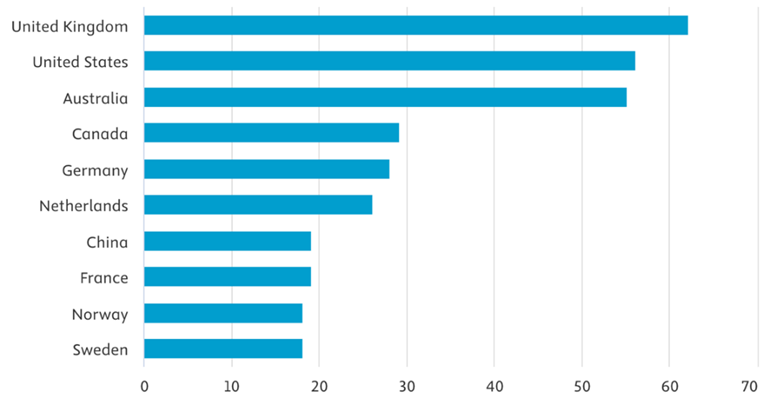
source : research data analysis in www.scopus.com, 2025
Research Cluster Analysis and Mapping
Understanding the structure and evolution of a research field requires more than identifying influential authors or highly cited publications; it demands an examination of how ideas coalesce, interact, and transform over time. In rapidly expanding and interdisciplinary domains such as maritime politics, knowledge production is marked by thematic convergence, conceptual fragmentation, and shifting research priorities. Bibliometric approaches provide a systematic means of capturing these dynamics by moving beyond linear narratives of scholarly progress toward relational and spatial representations of knowledge. Within this analytical framework, cluster analysis plays a pivotal role in revealing the underlying intellectual architecture of the field and in situating individual studies within broader patterns of conceptual organization and change.
Cluster analysis constitutes a foundational component of bibliometrics precisely because it enables scholars to map the intellectual landscape of a scientific domain in a structured and replicable manner. Its first objective is to identify key thematic clusters that represent the core research topics around which scholarly debates are organized. By grouping publications, keywords, or authors based on patterns of similarity and co-occurrence, cluster analysis makes visible the dominant themes as well as emerging or marginal research areas. The second objective is to examine the relationships between these themes through networks of co-occurrence and citation, thereby illuminating how concepts, methods, and theoretical perspectives are interconnected across the literature. Such relational analysis reveals not only the density and cohesion of specific clusters but also the bridges and overlaps that link different strands of research. The third objective is to visualize the temporal development and transformation of the field, allowing researchers to trace how thematic clusters evolve, merge, or decline over time. In doing so, cluster analysis provides critical insight into the dynamic trajectory of maritime politics scholarship, highlighting shifts in research focus, the emergence of new problem framings, and the reconfiguration of intellectual priorities within the field.
Research Cluster Analysis
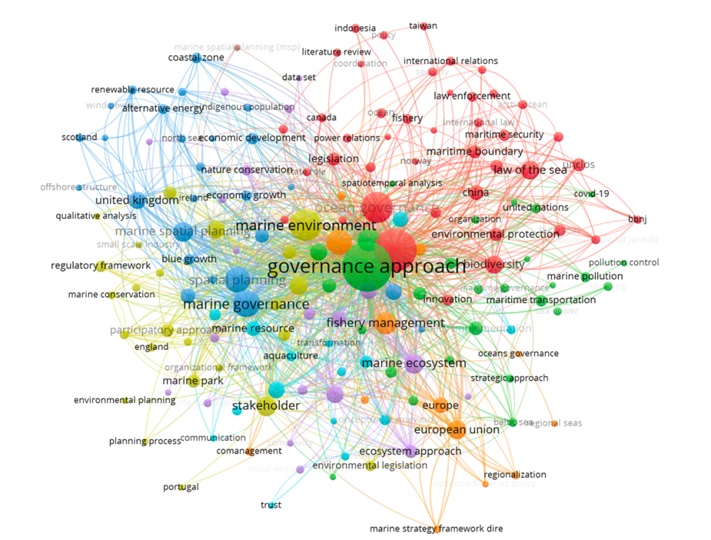
This analytical step delineates the thematic and intellectual structure of the scientific domain. It identifies distinct, interconnected, research clusters derived from patterns in keyword co-occurrence, author collaborations, and citation networks. Within bibliometrics, each cluster represents a knowledge community defined by a shared thematic focus and a coherent developmental trajectory. Consequently, this mapping elucidates not only the substantive focus of research ("what") but also the dynamic processes through which the field evolves, interacts, and forms new scientific paradigms ("how"). The findings of the cluster analysis are presented as follows).
source : research data analysis at VOSViewer,2025
Figure 1 presents a bibliometric network map illustrating the predominant thematic constructs within maritime politics scholarship over the period 2005–2025. In this visualization, each node represents a keyword extracted from the dataset (e.g., article titles and abstracts). The size of a node corresponds to its frequency of occurrence, with larger nodes indicating more prevalent terms in the literature. Nodes are clustered and color-coded based on their patterns of co-occurrence, forming distinct thematic groups that represent centralized research topics. The edges (lines) connecting the nodes signify a co-occurrence relationship, where the thickness of an edge is proportional to the strength of association between two keywords, thereby revealing the conceptual linkages that define the field's intellectual structure.
Analysis of the bibliometric network reveals a core lexicon defining contemporary maritime political studies, with the most frequent keywords being marine policy, governance approach, marine environment, ocean governance, and marine governance. A semantic examination of these terms clarifies their distinct conceptual domains. Marine Policy constitutes a broad conceptual umbrella, encompassing maritime law and governance, environmental conservation, security and geopolitics, economics and industry, coastal communities and society, and innovation and technology; Governance Approach refers to the prevailing paradigm for managing maritime and coastal areas, characterized by an emphasis on integrated, collaborative, and sustainable frameworks; Marine Environment is predominantly discussed in the context of systemic economic and energy transitions, particularly driven by the global emergence of the blue economy and renewable energy agendas; Ocean Governance concerns the architecture of coordination among diverse actors and across multiple levels of government in the global maritime commons; Marine Governance, by contrast, typically addresses management frameworks and regulatory instruments at national and regional scales.
To systematically delineate the intellectual structure of the field, Table 1 provides a detailed breakdown of the identified research clusters and their onstituent conceptual elements.
| Cluster | Group of research themes | |
|---|---|---|
| Elements of concept | Numbers of concept | |
| Cluster 1 | Artctic, artctic ocean, areas beyond national, bbnj, biodiversity, Canada, China, comparative study, coordination, environmental policy, environmental protection, fishery, fishing community, future prospect, geopolitics, government, high seas, Indonesia, innovation, international agreement, international cooperation, legislation, literature review, local government, marine policy, maritime boundary, maritime security, norwey, ocean, ocean governance, ocean policy, policy, power relations, security, state role, Taiwan, traditional knowledge, unclos | 42 items |
| Cluster 2 | Action plan, baltic sea, covid-19, decision making, governance approach, holistic approach, implementation process, integrated approach, marine pollution, maritime policy, maritime transportation, organization, pacific island, pacific ocean, policy analysis, policy approach, policy development, policy impelentation, policy making, pollution control, russian federation, sea power, shipping, spatiotemporal analysis, strategic approach, sustainable development, united nations | 28 items |
| Cluster 3 | Alternative energy, atlantic ocean, blue economy, blue growth, caribbean sea, coastal communities, coastal zone, economic development, economic growth, indigenous population, Ireland, marine governance, marine renewable energy, marine spatial planning, new zealand, north sea, offshore structure, renewable resource, resource development, resource management, Scotland, spatial planning, transboundary cooperation, united kingdom, united states, wind power | 26 items |
| Cluster 4 | Adaptive management, brazil, climate change, coastal zone management, conservation management, England, environmental change, environmental economic, environmental legislation, environmental planning, equity, fisheres management, knowledge, marine conservation, marine environment, marine park, organization framework, participatory approach, perception, planning process, Portugal, qualitative analysis, regulatory framework, small scale industry, stakeholder | 25 items |
| Cluster 5 | Anthozoa, complexity, conservation, data set, ecosystem approach, ecosystem management, ecosystem service, ecosystem-based management, environmental management, exclusive economic zone, human activity, industrialization, institutional framework, marine, marine ecosystem, maritime spatial planning, nature conservation, resilience, social-ecological system, soloman island | 20 items |
| Cluster 6 | Aquaculture, australia, collective action, communication, conceptual framework, global ocean, governance, local participation, marine protected areas, marine resource, protected area, sustainable development, theoritical study, transformation, trust | 15 items |
| Cluster 7 | Comanagement, common fisheries policy, Europe, europen union, fisheries, fishery management, fishery policy, marine strategiy framework, mediterrance sea, oceans governance, regional seas, regionalization, sustainability | 13 items |
| Cluster 8 | Marine spatial planning | 1 item |
source : research data analysis at VOSViewer, 2025
Comprising 42 items, Cluster 1 is anchored by the field's most prominent keyword. i.e. "marine policy." Its high frequency and strong associative links with concepts such as security, governance, and sustainability position it as the key nexus within maritime political scholarship over the past two decades. This indicates that marine policy serves as the primary conceptual framework through which diverse maritime issues are integrated and analyzed.
At the second cluster consisting of 28 items, is dominated by the "governance approach" keyword. Its prominence reflects a fundamental epistemological shift from state-centric government to multi-actor governance. This transition is necessitated by the ontological nature of the ocean as a global commons and transboundary space, which resists unilateral state control. This perspective is supported by Bueger (2015), who argues that effective ocean management necessitates complex networks involving states, international institutions, the private sector, and local communities interacting across multiple regimes.
Cluster 3, with 26 items, is led by the keyword "marine environment," a term characterized by its dual conceptualization. First, it refers to the physical-ecological system requiring sustainable management. Second, it has emerged as a critical political arena where competing interests—including energy, economics, and security—converge and are negotiated. The rising scholarly focus on this term parallels the escalating global discourse on climate change, the blue economy, and sustainable development. Consequently, the marine environment acts as a critical juncture between ecological and economic imperatives, thereby reinforcing the centrality of sustainability within maritime politics.
Cluster 4, comprising 25 concepts, is defined by the keyword "ocean governance." Its prominence signifies a scholarly trend toward the challenges of managing shared resources, governing areas beyond national jurisdiction, and navigating multilateral diplomatic processes. This keyword functions as an overarching framework for diverse issues, including marine biodiversity, climate adaptation, and high seas fisheries. Furthermore, it has become a central discursive arena for contestation between developed and developing states over equitable access and the fair distribution of benefits derived from marine resources.
The fifth cluster, containing 20 items, is led by the keyword "marine governance." This concept emphasizes the critical role of participatory decision-making, specifically highlighting the inclusion of coastal communities, fishers, and Indigenous groups in the management of marine resources. Subsequent clusters (6, 7, and 8), featuring keywords such as "governance," "fisheries governance," and "marine spatial planning," further delineate the specific institutional and technical mechanisms through which governance is operationalized.
Collectively, the mapping results demonstrate that maritime political studies constitute a fundamentally multidimensional and multi-scalar field. The core lexicon—"marine policy," "governance approach," "marine environment," "ocean governance," and "marine governance"—represents more than just research topics; it signifies an epistemic shift in comprehending the ocean as a complex socio-ecological and political system. This conceptual constellation reveals that contemporary maritime politics is defined by the intricate management of power relations, resource allocation, and knowledge production within the increasingly vital and contested "blue space," which is critical for the future of the planet.
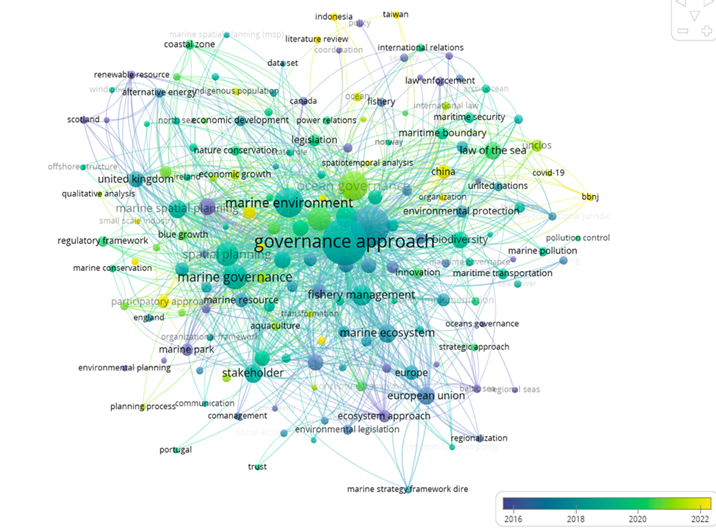
Furthermore, the bibliometric analysis provides a temporal dimension to the thematic mapping. The color gradient applied to the nodes represents the average publication year of articles associated with each keyword. This visualization allows for the identification of emerging, persistent, and declining research trends, thereby tracing the evolution of scholarly focus within maritime politics over the studied period.
source : research data analysis at VOSViewer, 2025
The temporal analysis reveals a distinct conceptual migration within the field. The keyword "marine policy" peaked in scholarly usage around 2016. Subsequently, a shift occurred with terms such as "marine governance," "marine environment," and "governance approach" gaining prominence from 2018–2019. Most notably, "ocean governance" has emerged as the most frequent keyword in recent years, with its prevalence accelerating between 2021 and 2022. This evolution illustrates the dynamic and responsive nature of research agendas and helps to identify both emerging frontiers and potentially understudied themes. The conceptual shift from 2016 to 2022 signifies an expanding research landscape that builds upon foundational concepts while opening new avenues for inquiry.
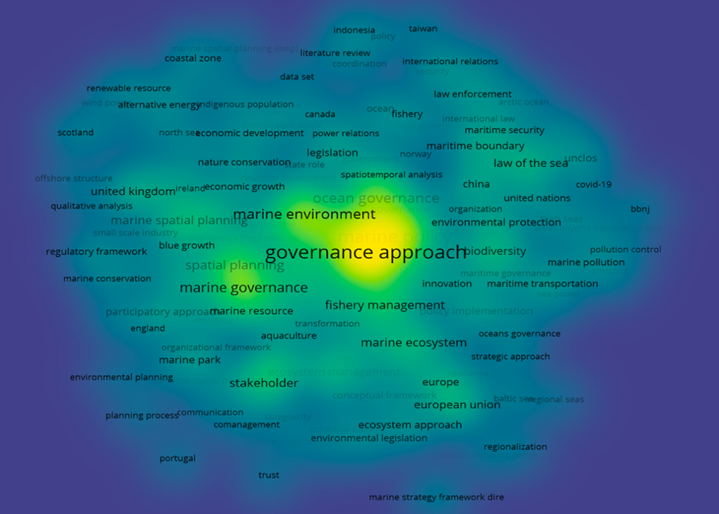
Following the analysis of keyword frequency and evolution, the final analytical step examines network density. This involves mapping the interconnectedness of keywords based on their co-occurrence within the literature. The varying color saturation and line thickness within the network visualization represent the density and dominance of specific thematic clusters, thereby revealing the core versus peripheral areas of scholarly discourse.
source : research data analysis at VOSViewer, 2025
Figure 3 illustrates the thematic structure of the field, where color saturation denotes the discursive dominance of each topic cluster. The most saturated clusters comprising the core concepts of marine policy, governance approach, marine environment, ocean governance, and marine governance exhibit the strongest and most complex interlinkages. This dense conceptual scaffolding provides a clear framework for analyzing the evolution and central tendencies of research in maritime politics.
Conclusion
The bibliometric mapping of maritime political studies over the past two decades reveals a profound epistemological shift in the field. The maritime domain is no longer understood primarily as a static space for geopolitical contestation or economic expansion, but rather as a dynamic, fluid political arena saturated with layered power relations. Network analysis identifies five core concepts—marine policy, governance approach, marine environment, ocean governance, and marine governance—which collectively signal a fundamental transformation in the conceptual foundations of the field. These concepts do not operate as isolated themes; instead, they constitute an integrative paradigm that views policy, governance, and environmental interests as interdependent components within a complex and mutually constituted socio-ecological system.
It is within this context that maritime politics has become increasingly salient and compelling in Australia. As a continental island state with an extensive maritime territory, Australia positions the ocean at the center of sovereignty, national security, economic development, and environmental governance. This centrality is not merely geographical, but also political and institutional, as reflected in state policies, marine legal frameworks, and sustained investments in research. The dominance of early clusters focused on marine policy and governance in the bibliometric mapping suggests that the Australian context provides a “natural laboratory” for the development of maritime politics as a field of study, where the dynamics between the state, markets, local communities, and global environmental regimes can be observed empirically and systematically.
Furthermore, this development points to a shift toward a more hybrid and systemic knowledge structure, moving away from traditional, fragmented, and sectoral approaches. The discursive transition from state-oriented “marine policy” to multi-stakeholder “governance approaches,” and ultimately to the global framework of “ocean governance,” reflects a fundamental transformation in how power is exercised within maritime spaces. In the Australian context, this transformation is reinforced by the involvement of non-state actors, international environmental regimes, and the recognition of Indigenous sea country, which challenges singular models of sovereignty and opens space for more inclusive forms of maritime citizenship.
Thus, the prominence of maritime politics in the Australian context cannot be understood merely as a consequence of extensive maritime interests, but rather as the outcome of a convergence between geopolitical positioning, state policy orientation, interdisciplinary research institutionalization, and the dynamics of global ocean governance. This convergence positions Australia not only as an object of maritime political inquiry, but also as a key site of knowledge production that significantly shapes the theoretical directions and practical configurations of contemporary maritime politics within an increasingly polycentric global order.
Bibliography
Aria, M., & Cuccurullo, C. (2017). bibliometrix: An R-tool for comprehensive science mapping analysis. Journal of Informetrics, 11(4), 959–975. https://doi.org/10.1016/j.joi.2017.08.007.
Bender, C. S., & Leodir Lobler, M. (2023). How Complex Is It To Understand Complexity? Revista Administração Em Diálogo - RAD, 25(1), 64–84. https://doi.org/10.23925/2178-0080.2023v25i1.56458
Bueger, C. (2015). Learning from piracy: future challenges of maritime security governance. Global Affairs, 1(1), 33–42. https://doi.org/10.1080/23340460.2015.960170
Bueger, C., & Edmunds, T. (2020). Blue crime: Conceptualising transnational organised crime at sea. Marine Policy, 119. https://doi.org/10.1016/j.marpol.2020.104067
Campling, L., Havice, E., Virdin, J., Carmine, G., Andriamahefazafy, M., Barbesgaard, M., Chakravarty, S., Gorez, B., Hetherington, D., Kim, H., Mfodwo, K., & Standing, A. (2024). A geopolitical-economy of distant water fisheries access arrangements. NPJ Ocean Sustainability, 3(1). https://doi.org/10.1038/s44183-024-00060-y
Carradore, M. (2024). A Bibliometric Analysis on the Topic of Social Policy. Social Sciences, 13(10). https://doi.org/10.3390/socsci13100524
Donthu, N., Kumar, S., Pandey, N., & Lim, W. M. (2021). Research Constituents, Intellectual Structure, and Collaboration Patterns in Journal of International Marketing: An Analytical Retrospective. Journal of International Marketing, 29(2), 1–25. https://doi.org/10.1177/1069031X211004234
Donthu, N., Kumar, S., & Pattnaik, D. (2020). Forty-five years of Journal of Business Research: A bibliometric analysis. Journal of Business Research, 109, 1–14. https://doi.org/10.1016/j.jbusres.2019.10.039
Ellegaard, O., & Wallin, J. A. (2015). The bibliometric analysis of scholarly production: How great is the impact? Scientometrics, 105(3), 1809–1831. https://doi.org/10.1007/s11192-015-1645-z
Havice, E. (2021). The environmental geopolitics of allocation: State power and institutional stability in Eastern Atlantic bluefin tuna management. Political Geography, 88. https://doi.org/10.1016/j.polgeo.2021.102395
Oxman, B. H. (2020). High Seas Governance: Gaps and Challenges. Edited by Robert C. Beckman, Millicent McCreath, J. Ashley Roach, and Zhen Sun. Leiden/Boston: Brill Nijhoff, 2018. Pp. xvii, 318. Index. American Journal of International Law, 114(4), 796–802. https://doi.org/DOI: 10.1017/ajil.2020.56
Petersen, K., Feldt, R., Mattsson, M., & Mujtaba, S. (2008). Systematic Mapping Studies in Software Engineering. https://www.researchgate.net/publication/228350426
Satnarine, T. (2023). Systematic Review Methodology: Conducting High-Quality Reviews and Understanding Their Significance in Evidence-Based Practice. Journal for International Medical Graduates, 6(5).
Summers, T. (2023). Maritime politics as discourse in the Indo/Asia-Pacific. Territory, Politics, Governance, 11(3), 572–589. https://doi.org/10.1080/21622671.2021.1886977